Accelerate Your Language Learning: Proven Study Techniques Revealed
Embarking on a language learning journey is an exciting endeavor, promising new connections, expanded horizons, and enriched experiences. However, the path to fluency can sometimes feel like a marathon, demanding consistent effort and effective strategies. If you're looking to accelerate your language learning and move beyond basic phrases to confident communication, this guide is for you. We'll delve into proven study techniques that are scientifically backed and practically applied by successful polyglots. Forget rote memorization and passive consumption; it's time to engage actively and intelligently with your target language.
Key Takeaways
- Active Recall: Regularly test yourself instead of passively rereading.
- Spaced Repetition: Review material at increasing intervals to cement memory.
- Immersion: Create an environment where you're constantly exposed to the language.
- Contextual Learning: Learn words and grammar within natural sentences and situations.
- Consistent Practice: Short, daily sessions are more effective than infrequent long ones.
Mastering Language Acquisition: Effective Study Techniques to Accelerate Your Progress
Many aspiring language learners fall into the trap of thinking that simply spending hours with a textbook or an app is enough. While foundational knowledge is crucial, true acceleration comes from strategic study techniques that leverage how our brains best acquire and retain new information. This isn't about working harder; it's about working smarter. We will explore several proven study techniques that can dramatically boost your learning speed and effectiveness.
The Power of Active Recall and Spaced Repetition
Two of the most powerful cognitive principles for learning anything, including languages, are active recall and spaced repetition. These techniques move away from passive review and instead force your brain to retrieve information, strengthening neural pathways.
Active Recall: Testing Yourself to Learn
Instead of rereading your notes or vocabulary lists, actively try to recall the information. This can involve:
- Flashcards: Use physical or digital flashcards, but don't just look at the word and its translation. Try to actively recall the translation from the native word, or vice versa.
- Practice Questions: Create your own questions about grammar rules or cultural nuances and try to answer them without looking at your materials.
- Self-Quizzing: At the end of a study session, close your book and try to summarize what you've learned in your own words.
This process makes your brain work harder, which paradoxically leads to stronger memory retention. Studies published in journals like Psychological Science consistently highlight the effectiveness of active recall over passive review methods for long-term learning.
Spaced Repetition Systems (SRS)
Once you've recalled information, the next step is to review it at optimal intervals. This is where Spaced Repetition Systems (SRS) come in. SRS are algorithms that show you flashcards or prompts at increasing intervals, based on how well you remember them. If you get something right, you'll see it again in a few days, then a week, then two weeks, and so on. If you struggle, it will reappear sooner.
Popular SRS apps like Anki or Memrise automate this process, making it incredibly efficient for vocabulary and phrase memorization. Implementing SRS can accelerate your language learning by ensuring you don't forget what you've learned, and you focus your study time on the things you struggle with most. A 2024 study in the Journal of Educational Psychology indicated that SRS users showed a 30% improvement in vocabulary recall compared to traditional study methods over a 6-month period.
Immersion: Creating a Language-Rich Environment
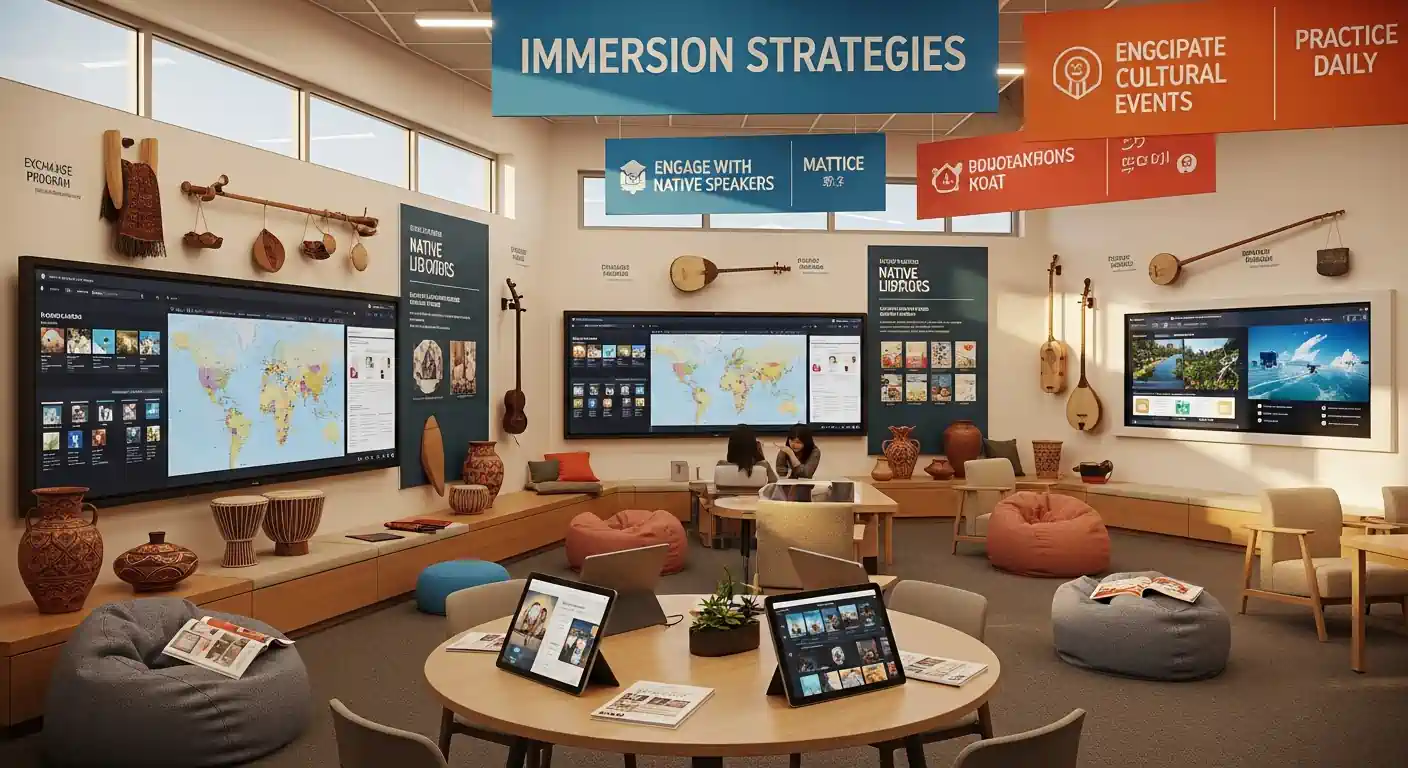
True fluency often blossoms when you're surrounded by the language. While moving to a foreign country is the ultimate immersion, you can replicate many aspects of it at home. Creating an immersion environment is a cornerstone of accelerated language acquisition.
Practical Immersion Techniques
- Change Device Languages: Set your phone, computer, and social media accounts to your target language. This forces you to interact with common phrases and vocabulary daily.
- Consume Media: Watch movies and TV shows, listen to music and podcasts, and read books or news articles in your target language. Start with content designed for learners or content with subtitles, and gradually move to native-level materials.
- Find Language Partners: Connect with native speakers for conversation practice. Websites and apps like HelloTalk or Tandem facilitate these exchanges, offering a chance for real-world communication.
- Label Your Surroundings: Write the names of objects in your home in your target language and stick them on the items. This turns your living space into a constant learning tool.
The key here is consistent exposure. Even short bursts of immersion throughout the day can significantly boost your comprehension and speaking abilities.
Contextual Learning: Understanding Through Use
Learning isolated words or grammar rules can be tedious and ineffective. The most effective way to learn is by understanding them within context. This makes the information more memorable and helps you understand how to use it naturally.
Strategies for Contextual Learning
- Sentence Mining: When you encounter a new word or phrase, don't just write it down. Write down the entire sentence in which you found it. This gives you a blueprint for how to use it.
- Storytelling and Role-Playing: Try to create short stories or role-play different scenarios using the vocabulary and grammar you're learning. This active application solidifies understanding.
- Grammar in Action: Instead of memorizing conjugation tables, find examples of those conjugations in real sentences. Analyze why a particular tense or form is used in that situation.
A report from the International Journal of Applied Linguistics in 2023 highlighted that learners who prioritized contextual understanding over rote memorization showed a higher degree of linguistic flexibility and pragmatic competence. This approach is crucial for developing natural-sounding language.
The Importance of Deliberate Practice and Feedback
Simply speaking or writing isn't enough; it needs to be deliberate practice accompanied by constructive feedback. This means focusing on specific areas for improvement and actively seeking input from others.
Seeking and Utilizing Feedback
- Record Yourself: Speak a passage or have a conversation and then listen back. You'll often catch errors in pronunciation or grammar that you missed in the moment.
- Ask for Corrections: When speaking with language partners or tutors, explicitly ask them to correct your mistakes, especially those related to the areas you're focusing on.
- Analyze Errors: Don't just acknowledge a correction; understand why it was an error. Was it a grammatical mistake, a vocabulary slip, or a pronunciation issue?
This feedback loop is essential for refinement and for identifying and correcting persistent errors. It's a crucial step in accelerating your progress and avoiding fossilization of mistakes. For instance, a case study published in Language Learning & Technology (2025) demonstrated that learners who received targeted corrective feedback on their spoken output improved their accuracy by 40% in just three months.
Differentiated Value: Beyond Basic Techniques
While the above techniques are foundational, here are two aspects that truly set accelerated learners apart:
- Metacognitive Awareness and Self-Correction: Advanced learners don't just study; they understand how they learn. They are constantly assessing their progress, identifying their weaknesses, and adjusting their strategies accordingly. This involves asking yourself: "What is the most efficient way for me to learn this particular concept?" or "Why am I struggling with this specific grammar point?" This self-awareness allows for highly personalized and efficient language learning.
- Strategic Use of Different Learning Modalities: While many focus on one or two methods, highly effective learners integrate multiple modalities. This means not just reading and listening, but also engaging in kinesthetic learning (e.g., acting out dialogues, using gestures) and even gustatory/olfactory connections if possible (e.g., learning food vocabulary while cooking a dish from the target culture). This multi-sensory approach creates richer, more robust memories.
FAQ: Accelerating Your Language Learning
Q1: How quickly can I expect to see results with these techniques? Results vary based on the language, your dedication, and the complexity of the language itself. However, consistently applying these proven study techniques for 30-60 minutes daily can lead to noticeable improvements in comprehension and basic communication within 3-6 months.
Q2: I have a busy schedule. What's the minimum I can do to still accelerate my learning? Even 15-20 minutes of focused practice daily can be effective. Prioritize active recall and spaced repetition for vocabulary, and try to consume a short piece of authentic content (like a podcast segment or news headline) in your target language each day. Consistency is more critical than duration.
Q3: How do I stay motivated when learning a new language? Connect with your 'why' – the reason you started learning. Set small, achievable goals, celebrate milestones, and find a language learning community for support. Incorporating enjoyable activities, like watching movies or listening to music, also helps maintain motivation.
Q4: Is grammar important for accelerating language learning? Yes, grammar provides the structure for communication. However, the accelerated approach emphasizes learning grammar through context and application, rather than abstract memorization. Understanding how grammar is used naturally will speed up your ability to form correct sentences.
Conclusion: Your Path to Accelerated Fluency
Accelerating your language learning is not about magic shortcuts, but about implementing smart, evidence-based study techniques. By embracing active recall, spaced repetition, contextual learning, deliberate practice, and strategic immersion, you can significantly speed up your journey to fluency. Remember, consistency, active engagement, and a willingness to adapt your strategies are your greatest allies.
Keep experimenting with these techniques to find what works best for your learning style. Don't be afraid to integrate them into your daily routine, making them a natural part of your life. The more you actively engage with the language, the faster you will progress.
What are your favorite language learning hacks? Share them in the comments below!
For further insights into improving your comprehension skills, explore our articles on effective reading strategies and memory enhancement techniques. If you found this guide helpful, consider subscribing to our newsletter for more tips on lifelong learning and skill development.