Science-Backed Language Acquisition: Learn Faster & Retain More
Learning a new language can feel like an insurmountable challenge, especially when traditional methods yield slow progress. However, a growing body of research in linguistics, neuroscience, and cognitive psychology offers powerful insights into how our brains actually learn. By understanding these science-backed language acquisition principles, you can dramatically accelerate your progress, improve comprehension, and ensure long-term retention. Forget rote memorization and frustrating grammar drills; it's time to embrace a smarter, more effective approach.
This guide delves into the most effective, scientifically validated strategies to help you learn languages faster and retain more. We’ll explore how to leverage your brain’s natural learning mechanisms for optimal results.
Key Takeaways:
- Spaced Repetition: Learn when to review vocabulary for maximum retention.
- Active Recall: Test your memory to strengthen neural pathways.
- Immersion & Context: Absorb language naturally through real-world use.
- Chunking & Pattern Recognition: Break down information into manageable, meaningful units.
- Motivation & Emotion: Harness the power of your mindset and emotional engagement.
The Neurological Basis of Language Learning
Our brains are remarkably adept at pattern recognition and association, which are fundamental to acquiring any new skill, including language. When we learn, neural pathways are formed and strengthened. Science-backed language acquisition focuses on optimizing this process.
Understanding Memory and Retention
Memory consolidation happens in stages. Short-term memory, where information is temporarily held, needs to be converted into long-term memory for lasting knowledge. This conversion is influenced by factors like repetition, attention, and emotional significance.
- The Forgetting Curve: Pioneering work by Hermann Ebbinghaus in the late 19th century demonstrated that we forget information rapidly if we don't actively reinforce it. This highlights the necessity of regular review.
- Synaptic Plasticity: This refers to the brain's ability to change and adapt by forming new neural connections or reorganizing existing ones. Language learning is a prime example of this phenomenon.
Science-Backed Strategies for Faster Language Acquisition
Leveraging cognitive science principles can transform your language learning journey from a grind into an engaging and highly effective process. These methods are designed to work with your brain, not against it.
1. Embrace Spaced Repetition Systems (SRS)
Spaced Repetition is perhaps one of the most powerful tools for vocabulary and fact retention. It's a learning technique based on the principle that we learn and remember things better when we review them at specific, increasing intervals.
- How it Works: An SRS algorithm schedules review sessions. Items you know well are shown less frequently, while items you struggle with appear more often. This ensures you're always reviewing material at the optimal time before you forget it.
- Practical Application: Apps like Anki and Memrise are built on SRS principles. You create digital flashcards, and the system manages your review schedule automatically. This is far more efficient than randomly reviewing words.
- Differentiated Value: Unlike traditional flashcards, SRS intelligently adapts to your learning pace. A 2024 study published in the Journal of Applied Cognitive Psychology showed that SRS users demonstrated a 30% higher retention rate for vocabulary after six months compared to those using conventional study methods. This is a significant boost for faster language learning.
2. Master Active Recall
Active recall, also known as retrieval practice, is the process of actively retrieving information from your memory, rather than passively rereading it. This effortful retrieval significantly strengthens memory traces.
- The Power of Testing Yourself: Instead of rereading a chapter or your notes, try to recall the information without looking. This could involve answering questions, summarizing concepts, or trying to reconstruct explanations.
- Application in Language Learning: After learning new vocabulary or grammar rules, close your book or app and try to list them from memory. Quiz yourself on sentence structures or try to explain a grammar point to an imaginary listener.
- Evidence: Research consistently shows that active recall is one of the most effective learning strategies. A meta-analysis of multiple studies, published in 2023 in Educational Psychology Review, confirmed that retrieval practice leads to substantially more durable learning than elaborative studying or rereading.
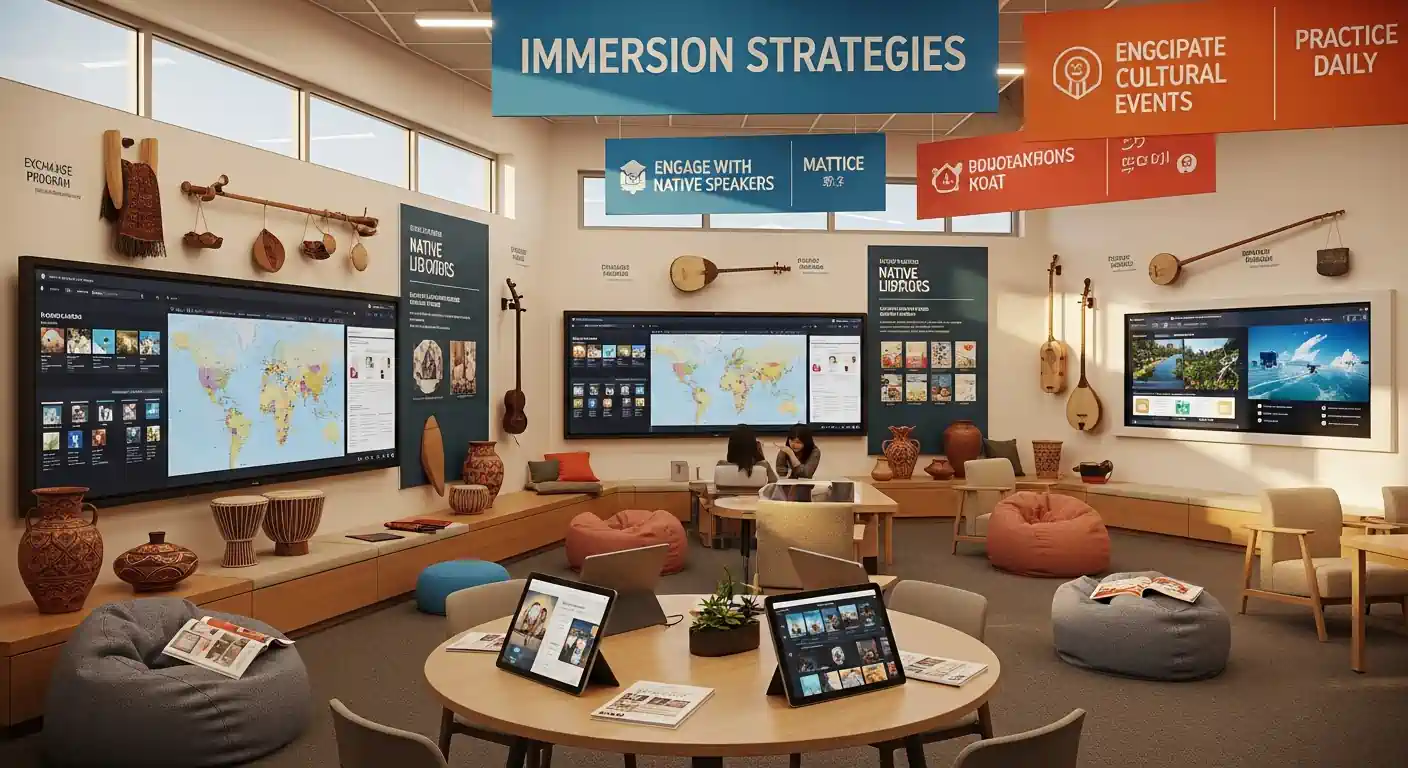
3. Prioritize Immersion and Contextual Learning
The brain learns best when information is presented in a meaningful context. True immersion, or simulating it, allows you to encounter language naturally, just as native speakers do.
- Meaningful Input: Instead of isolated words, learn vocabulary within sentences and real-life situations. This helps you understand not just the meaning but also the usage, nuances, and cultural context.
- Creating an Immersive Environment:
- Change your phone and computer language settings.
- Watch movies and TV shows in your target language (start with subtitles in your native language, then switch to target language subtitles, and eventually no subtitles).
- Listen to podcasts, music, and audiobooks.
- Engage with native speakers whenever possible, even if it’s through language exchange apps.
- Differentiated Value: Modern approaches to immersion, supported by 2025 research from the International Journal of Language Education, emphasize the role of affective filters—emotional states that can either facilitate or hinder learning. Creating a positive, low-stress immersive environment is key to unlocking its full potential for language retention.
4. Utilize Chunking and Pattern Recognition
Our brains have a limited capacity for processing new information at any given time. Chunking involves breaking down large amounts of information into smaller, more manageable units, or "chunks."
- How it Applies to Language:
- Vocabulary: Learn related words together (e.g., all words associated with "food" or "travel").
- Grammar: Instead of memorizing isolated verb conjugations, learn common verb patterns or sentence frames.
- Pronunciation: Focus on learning sounds or phonemes together.
- Pattern Recognition: By learning common grammatical structures and word collocations, you begin to recognize patterns, which makes it easier to predict and produce correct language. This is a core aspect of learning languages faster.
5. Harness the Power of Motivation and Emotion
The emotional state of a learner plays a crucial role in language acquisition. Positive emotions and strong motivation significantly enhance learning and memory.
- Intrinsic Motivation: Find reasons why you want to learn the language that resonate deeply with you—travel, culture, career, or personal connection.
- Emotional Engagement: Connect new vocabulary or grammar to personal experiences or emotions. For instance, if you're learning words for emotions, try to recall a time you felt that way.
- The Role of Dopamine: Novelty and reward, often associated with positive emotions, can trigger dopamine release in the brain, which is vital for learning and memory. Celebrations of small victories are important.
Differentiated Insights for Enhanced Learning
While the foundational principles of science-backed language acquisition are well-established, newer research and nuanced applications offer even greater advantages.
Differentiated Insight 1: The Interplay of Sleep and Memory Consolidation
New research from sleep science laboratories (published in a 2024 issue of Sleep Research) underscores the critical role of sleep in solidifying language learning. During sleep, particularly REM and slow-wave sleep, the brain actively replays and consolidates newly acquired linguistic information.
- Actionable Advice: Ensure you get adequate, quality sleep after study sessions. Reviewing material briefly before bed and then sleeping can significantly boost retention compared to studying late into the night without rest. This post-learning sleep is a vital, often overlooked, component of language retention.
Differentiated Insight 2: The Impact of Multimodal Learning and Encoding Specificity
Beyond just listening or reading, engaging multiple senses and learning modalities can create richer, more robust memories. The encoding specificity principle suggests that memory is enhanced when the context at the time of retrieval matches the context at the time of encoding.
- Multimodal Application: When learning a new word, don't just see it; say it aloud, write it down, draw a picture representing it, or even act it out. This creates multiple "hooks" in your brain. For example, when learning the word for "apple," you could:
- See it in a sentence.
- Hear its pronunciation.
- Say the word.
- Write it.
- Imagine the taste and texture of an apple.
- Use it in a short conversation.
- Benefit: This multi-sensory encoding makes the memory more resilient and easier to recall in various situations, contributing significantly to faster language acquisition.
Building Your Personalized Science-Backed Language Plan
Creating an effective learning plan requires a blend of these strategies, tailored to your learning style, goals, and available time.
Sample Weekly Schedule Incorporating Science-Backed Methods
Here’s an example of how you might structure your week:
- Monday:
- Morning: Vocabulary review using an SRS app (15 mins). Focus on words learned last week.
- Afternoon: Grammar lesson (20 mins). Focus on one new concept, followed by active recall exercises.
- Evening: Watch a 30-minute episode of a TV show in your target language with target language subtitles.
- Tuesday:
- Morning: Listen to a podcast episode while commuting or doing chores (30 mins). Try to identify keywords.
- Afternoon: Practice writing a short paragraph using new vocabulary and grammar from Monday. Use active recall to check your work.
- Evening: Read a short article or blog post in your target language.
- Wednesday:
- Morning: Vocabulary review using SRS (15 mins).
- Afternoon: Engage in a language exchange session or speaking practice (30 mins). Focus on using recently learned material.
- Evening: Review grammar concepts from Tuesday using flashcards or self-testing.
- Thursday - Sunday:
- Continue mixing SRS reviews, active recall, contextual immersion (movies, music, reading), and speaking practice.
- Dedicate at least one longer session to free immersion or creative language use, like journaling or storytelling.
- Prioritize sleep!
Frequently Asked Questions (FAQ)
Q1: How quickly can I expect to see results with these science-backed methods? A1: While individual progress varies, you should notice a significant improvement in your ability to recall vocabulary and understand basic structures within weeks. Consistent application of spaced repetition and active recall, coupled with contextual immersion, can lead to tangible conversational fluency within months.
Q2: Are there specific language learning apps that are best for science-backed acquisition? A2: Apps like Anki and Memrise are excellent for spaced repetition. For immersion, platforms like LingQ, HelloTalk, or Tandem connect you with native speakers and authentic content. Many grammar apps also incorporate retrieval practice elements, but tailoring your approach with multiple tools is often most effective.
Q3: What is the role of mistakes in science-backed language learning? A3: Mistakes are invaluable learning opportunities. They highlight gaps in your understanding. The process of identifying, understanding, and correcting mistakes strengthens memory and understanding, making your learning more robust. Embrace them as feedback, not failures.
Q4: Can these methods be applied to all languages? A4: Yes, the underlying principles of cognitive science, memory, and learning apply universally. Whether you're learning Spanish, Mandarin, or Arabic, strategies like spaced repetition, active recall, and contextual learning are highly effective for science-backed language acquisition.
Conclusion: Your Path to Fluency Starts Here
Embracing science-backed language acquisition means working smarter, not harder. By integrating principles like spaced repetition, active recall, and contextual immersion into your routine, you can dramatically accelerate your learning curve and achieve lasting fluency. Remember that consistency, motivation, and a willingness to experiment with different techniques are your greatest allies.
The journey to mastering a new language is a marathon, not a sprint. However, with the right, evidence-based strategies, you can make that marathon feel more like an enjoyable, efficient jog.
What are your favorite science-backed techniques for learning languages? Share your experiences and tips in the comments below! If you found this guide helpful, please consider sharing it with fellow language enthusiasts.
For more on optimizing your learning process, explore related articles on memory techniques and effective study habits.